

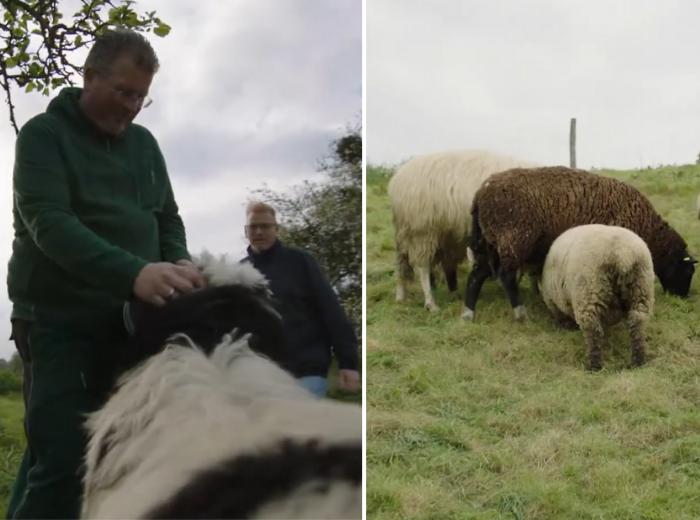
Something unexpected is happening on a sheep farm in Germany. The rams aren’t behaving the way farmers usually expect. They’re affectionate with one another, uninterested in ewes, and showing a preference that would normally get them written off as “useless” in traditional farming.

Image Credits: Rainbow Wool
Key Takeaways
- A German farmer named Michael Stücke created Rainbow Wool, a project that rescues rams who prefer other males and would otherwise be sent to slaughter.
- Research suggests a small percentage of male sheep consistently prefer other males, a trait often viewed as undesirable in traditional farming.
- Rainbow Wool raises these sheep for their wool instead of meat, donating all profits to LGBTQ+ charities and causes in Germany.
- The project gained international attention after the wool was used in a New York fashion show, sparking conversation about nature, acceptance, and compassion.
For farmer Michael Stücke, this behavior isn’t a phase or a fluke. He says it’s simply how some of his sheep are wired.
“They find each other attractive,” Stücke said of his flock. “It’s undeniable.”
Stücke, who has spent three decades raising sheep in Westphalia, is now known as the caretaker of what may be the world’s only flock of openly gay rams. Research suggests that around 8% of male sheep consistently prefer other males, but in modern farming, that trait is often treated as a problem. Rams that won’t breed are usually sent to slaughter.
That reality didn’t sit well with Stücke or his business partner, Nadia Leytes.
“We asked ourselves, what can we do to stop this from happening?” Leytes said.
Their answer became Rainbow Wool, a project that rescues gay rams by buying them directly from breeders and raising them for their wool instead of meat. Today, the flock includes 35 sheep, all saved from slaughter, with more waiting to be taken in.
Stücke, who is gay himself, says the project is personal.
“I know what it’s like to grow up feeling different, especially in a conservative environment,” he said. “My heart beats for the weak and the excluded.”
Image Credits: Rainbow Wool
The sheep are given names, sponsors, and space to live together. Their wool is processed at a mill in Spain, and all profits are donated to LGBTQ+ charities in Germany. Some of those funds have even helped relocate people from countries where being gay is illegal.
Identifying gay sheep isn’t as simple as it sounds. Stücke says it’s not about occasional same sex behavior.
“Some rams will jump on anything,” he explained. “That’s dominance, not preference. But if a ram consistently refuses to mate with females, that tells you something.”
Last month, the project took an unexpected turn toward fashion.
The wool from Rainbow Wool’s sheep was used to create a knitwear collection shown on a New York City runway. Designed by Michael Schmidt and sponsored by the dating app Grindr, the show featured 36 looks representing exaggerated male archetypes: from sailors and pool boys to leather clad figures.
Schmidt described the collection as more of an art project rather than a clothing line.
“The idea is simple,” he said. “Homosexuality exists in nature. It always has.”
That message resonated widely, but it also stirred debate.
For years, animal sexuality has fascinated researchers and the media alike. Much of the discussion traces back to biochemist Charles Roselli, whose work helped establish the statistic that roughly one in twelve rams is male oriented. His research, however, was once misrepresented, sparking controversy and accusations that he was trying to “cure” homosexuality, claims later shown to be false.
Rainbow Wool hasn’t faced the same level of backlash, but it hasn’t escaped criticism either. Some scholars argue that labeling animals as “gay” risks projecting human identities onto creatures that don’t experience sexuality the same way people do. Others say the project distracts from deeper ethical issues in farming itself.
Image Credits: Rainbow Wool
There have also been real world consequences. After receiving online threats, Stücke began moving the flock between locations to keep them safe.
Despite the criticism, Stücke remains grounded in what the project means to him.
“I don’t think animals are humans,” he said. “This isn’t about pretending they are. It’s symbolic.”
For him, caring for sheep that don’t fit expectations is about acceptance and choice.
“If we can save an animal simply for being different,” he said, “that sends a message.”
It may not solve every problem in agriculture or society. But for Stücke, and for the sheep in his care, it’s a small act of resistance and compassion.
–
It’s stories like these that bring people together and remind us of what truly matters. Small moments of care, empathy, and love can leave a lasting impact – not just on those involved, but on everyone who hears them.
Find more meaningful, feel-good stories on Simply Wholesome and stay connected with moments that uplift and inspire.











Leave a comment