

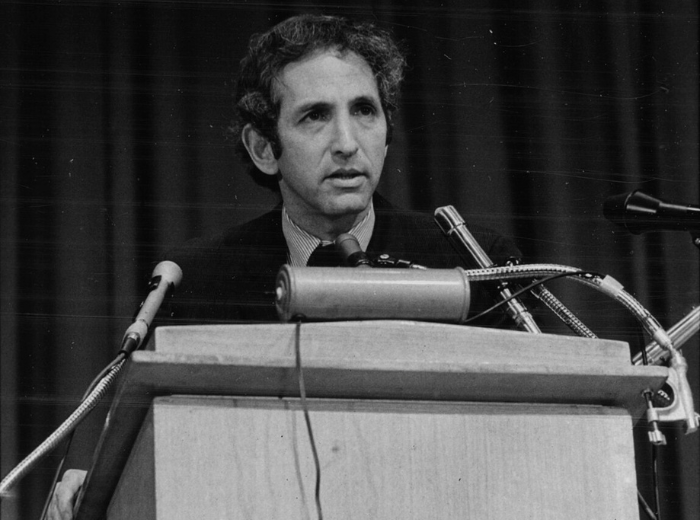
Credit: Daniel Ellsberg (Public Domain)
Daniel Ellsberg was an American political activist, economist, military analyst, and whistleblower whose actions altered the course of U.S. history. Born in Chicago on April 7, 1931, Ellsberg’s early life was marked by academic excellence and a deep interest in public policy. He graduated summa cum laude from Harvard University in 1952 with a degree in economics, later studying at King’s College, Cambridge, before returning to Harvard for postgraduate work.
Key Takeaways
- Daniel Ellsberg was a former U.S. military analyst who became one of the most influential whistleblowers in American history.
- He exposed the Pentagon Papers, revealing decades of government deception about the Vietnam War.
- His actions strengthened press freedom and reshaped public trust in government transparency.
- Ellsberg’s legacy continues to inspire whistleblowers and advocates for accountability worldwide.
Ellsberg also served as an officer in the United States Marine Corps from 1954 to 1957, reaching the rank of first lieutenant. His military service and academic training positioned him as a trusted voice in matters of national security. In 1959, he joined the RAND Corporation, a think tank closely linked to the U.S. Department of Defense. There, he completed a PhD in economics and gained recognition for his work in decision theory and strategic analysis.
In the mid-1960s, Ellsberg became directly involved in U.S. policy on the Vietnam War. He worked at the Pentagon under Defense Secretary Robert McNamara and later served in South Vietnam as a civilian analyst. These experiences changed him. On the ground, Ellsberg witnessed the human cost of the war and became increasingly troubled by the gap between official government statements and the reality he observed.
In 1967, Ellsberg returned to RAND and helped work on a classified government study titled “History of U.S. Decision-Making Process on Vietnam Policy.” The report, later known as the Pentagon Papers, documented decades of political and military decisions regarding Vietnam. The documents revealed that multiple U.S. administrations had knowingly misled the public and Congress about the scope, intentions, and progress of the war.
As Ellsberg read the report, he experienced a moral reckoning. He concluded that the American people had been systematically deceived and that continuing secrecy would only prolong suffering. By 1969, he secretly copied the documents with the help of colleague Anthony Russo. After unsuccessfully trying to persuade members of Congress to release them, Ellsberg decided to take a risk that would define his life.
In June 1971, Ellsberg leaked the Pentagon Papers to The New York Times, which began publishing excerpts. The Nixon administration attempted to block publication, citing national security concerns. The legal battle reached the U.S. Supreme Court, which ruled in favor of the press in a historic decision, affirming that prior restraint violated the First Amendment.
Ellsberg was soon charged under the Espionage Act, facing up to 115 years in prison. However, the case collapsed in 1973 after evidence emerged of serious government misconduct, including illegal wiretapping and a break-in at Ellsberg’s psychiatrist’s office by operatives tied to the White House. All charges were dismissed.
Rather than retreat from public life, Ellsberg became a leading advocate for peace, transparency, and whistleblower protection. He wrote extensively, including Secrets: A Memoir of Vietnam and the Pentagon Papers and The Doomsday Machine, which warned about the dangers of nuclear weapons. He publicly supported later whistleblowers and urged others to act sooner rather than later when confronting government wrongdoing.
Daniel Ellsberg died on June 16, 2023, at the age of 92. His legacy remains powerful. He demonstrated that one individual, guided by conscience, can challenge immense power and help shift the moral direction of a nation.Daniel Ellsberg’s story reminds us that democracy depends on truth, courage, and accountability. If you value thoughtful storytelling, historical reflection, and stories that center human conscience and integrity, explore more meaningful narratives at Simply Wholesome.












Leave a comment