

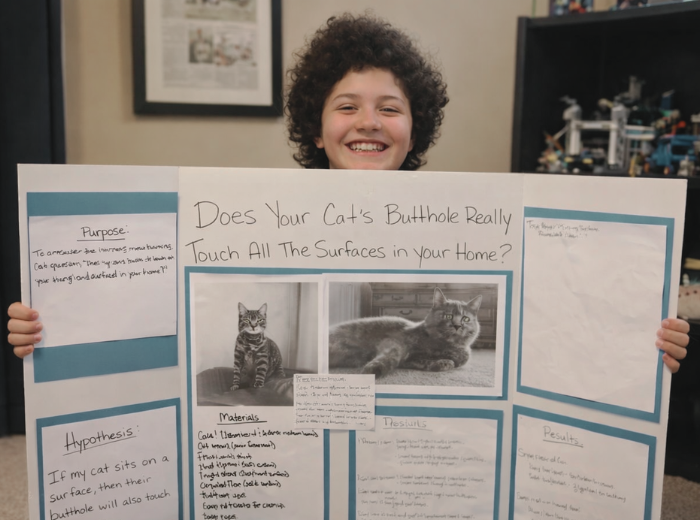
Sometimes the most memorable scientific questions come from simple curiosity. One middle-school student decided to explore a question that many cat owners have probably wondered about, but never actually tested.
The unusual experiment quickly went viral online because it was funny, creative, and surprisingly scientific at the same time.
Key Takeaways
Even funny questions can lead to meaningful scientific experiments.
Cats’ fur often prevents direct contact with surfaces when they sit.
Soft materials like bedding are more likely to show contact than hard surfaces.
The experiment demonstrates how curiosity and creativity are essential parts of science.
A homeschooled sixth-grade student named Kaeden Henry set out to answer a very unusual question for his school science fair:
“Does your cat’s butt actually touch the surfaces around your home?”
The idea may sound silly at first, but the young researcher approached it like a real scientific investigation.
With the help of his mother, who reportedly has expertise in animal behavior, Kaeden designed an experiment to test the theory in a safe and harmless way.
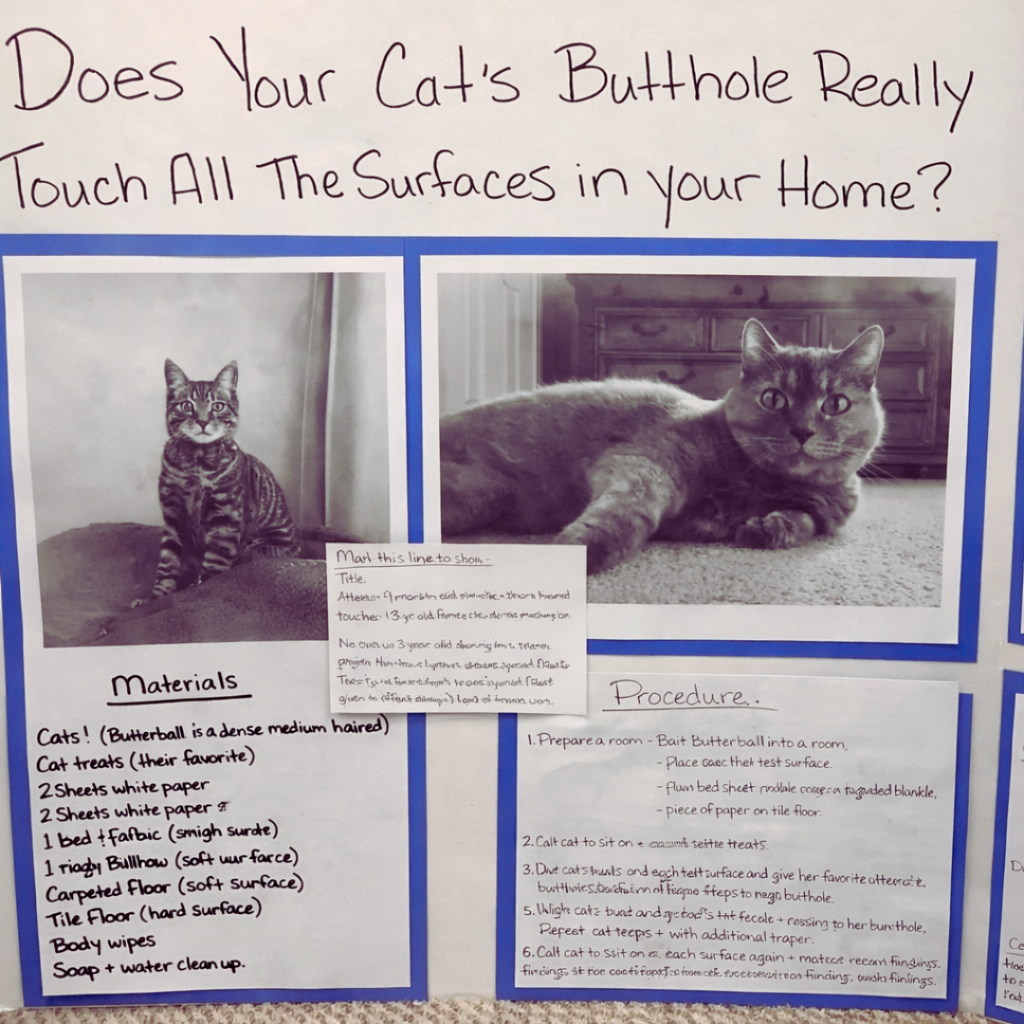
To find out whether cats make contact with household surfaces when they sit, Kaeden used a clever technique.
He applied non-toxic lipstick to the rear end of trained household cats. Then he asked the cats to perform simple actions like sitting or jumping onto different surfaces around the house.
After each test, he examined the surfaces to see whether the lipstick left any marks.
This allowed him to determine whether contact actually occurred.
The experiment tested different scenarios, including:
- Hard surfaces such as counters or floors
- Soft surfaces such as bedding or cushions
- Cats with long, medium, and short hair
The results were not what many people expected.
According to the findings:
- Long- and medium-haired cats: No contact was detected on either soft or hard surfaces.
- Short-haired cats: No contact occurred on hard surfaces, but there was slight evidence of contact on soft bedding.
In other words, your kitchen counters might be safer than you thought, but soft surfaces like blankets or laundry piles could occasionally be touched.
The experiment also showed how the fur around a cat’s tail and hindquarters acts like a natural barrier, preventing direct contact in many situations.
When Kaeden’s mother shared the project online, it quickly gained attention across social media.
The Facebook post alone received tens of thousands of reactions and shares, with many people praising the creativity behind the experiment.
People loved the project not only because it was funny but also because it demonstrated genuine scientific thinking.
The project is a great example of how curiosity drives discovery.
Science doesn’t always start with complex equipment or university laboratories. Sometimes it begins with a simple observation about everyday life.
In this case, a student noticed something many cat owners joke about—and decided to test it properly.
The experiment also shows the importance of creative thinking in science. By using lipstick as a harmless tracking marker, Kaeden created an easy way to collect evidence without hurting the animals.
The internet had plenty to say about the unusual project.
“This is the most useful science fair project ever.”
“I’m both relieved and slightly disturbed by these results.”
Twitter / X
“Kids asking the questions scientists are too afraid to ask.”
“This deserves a Nobel Prize in household hygiene.”
“This is peak scientific curiosity.”
“Honestly the methodology is solid.”
Many people said the project reminded them that science can be both educational and entertaining.
Sometimes the most memorable discoveries begin with the simplest questions. If you enjoy stories where curiosity leads to unexpected insights, share this article with a fellow animal lover.
For more fascinating and wholesome stories about animals, science, and everyday curiosity, explore more features on Simply Wholesome.















Leave a comment