

Credit: U.S Department of war
Sometimes a single moment defines a lifetime, not because it was planned, but because instinct and love for another human being took over.
For US Marine Corps Corporal William Kyle Carpenter, that moment came in November 2010, on a rooftop in Helmand Province, Afghanistan. In the middle of a Taliban attack, Carpenter and his fellow Marine, Lance Corporal Nicholas Eufrazio, were holding their position when a grenade was thrown directly at them. With no time to think and no regard for his own safety, Carpenter moved toward the grenade, placing his body between the blast and his friend.
Credit: U.S Department of war
Key Takeaways
- In 2010, US Marine Cpl William Kyle Carpenter shielded a fellow Marine from a live grenade during combat in Afghanistan, saving his life at the cost of his own health.
- He endured years of recovery, including more than 40 surgeries, extensive rehabilitation, and permanent injuries, demonstrating remarkable resilience beyond the battlefield.
- In 2014, he was awarded the Medal of Honor, recognizing not only his bravery in combat but his strength, humility, and perseverance afterward.
- Carpenter spent five weeks in a coma. When he awoke, his life had changed completely. His injuries were severe and life-altering. Over the next two and a half years, he lived largely in hospitals, enduring countless surgeries, skin grafts, and intensive rehabilitation. He had to relearn how to do things most people take for granted, including walking, eating, and even putting on his own socks.
The explosion nearly killed him. His helmet was shredded. His gear melted. He lost his right eye, suffered a collapsed lung, shattered his jaw, and sustained devastating injuries across his body. When fellow Marines reached him, they found him face down and gravely wounded. Yet even as he slipped into unconsciousness, Carpenter’s first concern was not for himself. He asked if Eufrazio was okay.
That single question speaks volumes.
The transition was humbling. Carpenter later reflected on how difficult it was to go from carrying a machine gun in combat to needing help with the most basic tasks. Yet instead of bitterness, he found perspective. Those long months, he said, reshaped how he viewed life, gratitude, and resilience in ways that no ordinary experience ever could.
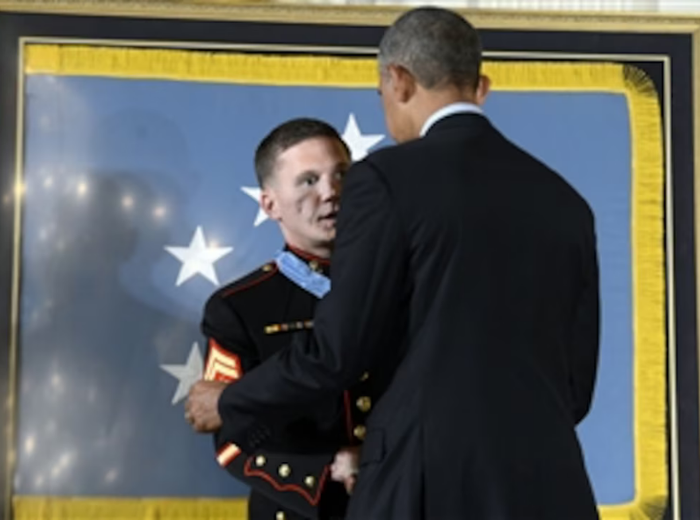
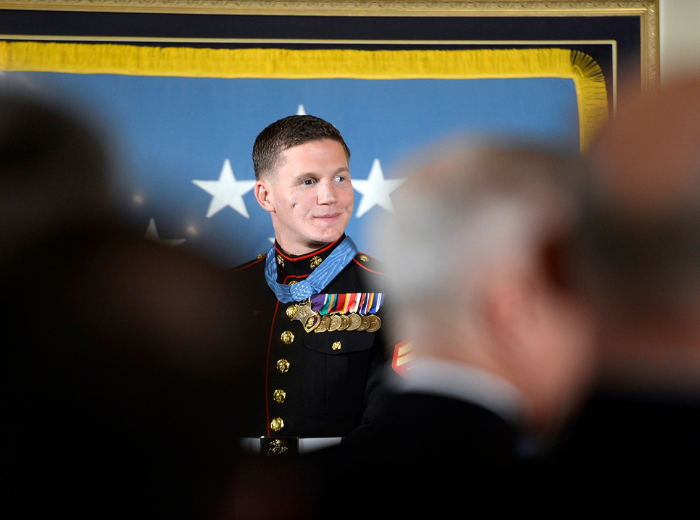
In June 2014, nearly four years after the explosion, Carpenter stood at the White House as then-President Barack Obama awarded him the Medal of Honor, the nation’s highest military decoration. During the ceremony, President Obama emphasized not only Carpenter’s heroism in combat, but his courage afterward, the daily bravery it took to recover, endure pain, and rebuild his life.
The president spoke about the visible scars and the unseen ones, about the surgeries, the brain trauma, and the prosthetic eye. He spoke about Carpenter’s smile, a symbol of the spirit that carried him through years of hardship. He also honored the medical teams who worked tirelessly to save Carpenter’s life, whom Carpenter himself credited with “putting me back together.”
By the time of the ceremony, Carpenter had been medically retired from the Marine Corps and had begun a new chapter as a full-time student at the University of South Carolina. His uniform had changed, but his sense of purpose had not. He carried forward not as a symbol of war, but as a living example of sacrifice, friendship, and quiet strength.
Carpenter became one of only a small number of living veterans from the Iraq and Afghanistan conflicts to receive the Medal of Honor. Yet what set him apart was not how he spoke about heroism, but how little he claimed it for himself. He consistently framed his actions as instinctive, something anyone would do for a fellow Marine.
But history tells us otherwise. Acts like his are rare not because people lack courage, but because true selflessness demands everything in a single instant.
Today, Carpenter’s story stands as a reminder that heroism does not end when the battle does. Sometimes the greatest bravery comes afterward, in recovery rooms, in physical therapy sessions, and in choosing hope when life has been irrevocably altered. His journey reflects not only the cost of service, but the enduring power of resilience, gratitude, and brotherhood.
If stories like William Kyle Carpenter’s, stories that honor courage, compassion, and the quiet strength of the human spirit, resonate with you, you’ll find many more at Simply Wholesome. Our platform is dedicated to sharing meaningful, uplifting historical and real-life stories that remind us of what truly matters: sacrifice, kindness, and the enduring capacity to rise after hardship.









Leave a comment